

A facility condition assessment tells you what needs attention. A capital plan must determine what to do, when to do it, and why. Learn how leading organizations connect assessment data to needs, projects, forecasts, and defensible capital decisions.
From Facility Condition Assessment to a Defensible Capital Plan
A defensible capital plan isn't just a list of projects; it's a traceable system that connects facility conditions, needs, costs, priorities, projects, budgets, and outcomes.

Facility condition assessments are supposed to answer a relatively simple question:
What needs to be fixed, and how much will it cost?
But for organizations managing hundreds, or thousands, of facilities, that is only the beginning.
A useful facility condition assessment must ultimately support much bigger decisions:
- Which needs are most urgent?
- What should be fixed first?
- How much will each project actually cost?
- Which needs should be bundled into projects?
- What happens if funding changes?
- How do you balance facility conditions with enrollment, growth, sustainability, or other strategic priorities?
- Can you explain why a project is in the capital plan?
- And can you trace that decision back to the original facility data?
That is the difference between collecting facility data and building a defensible capital plan.
After years of working with large-scale facility assessment and capital planning programs, Intellis CEO and founder Steven Warshaw has seen that the strongest programs follow a connected process:
Assess → Analyze → Package → Forecast
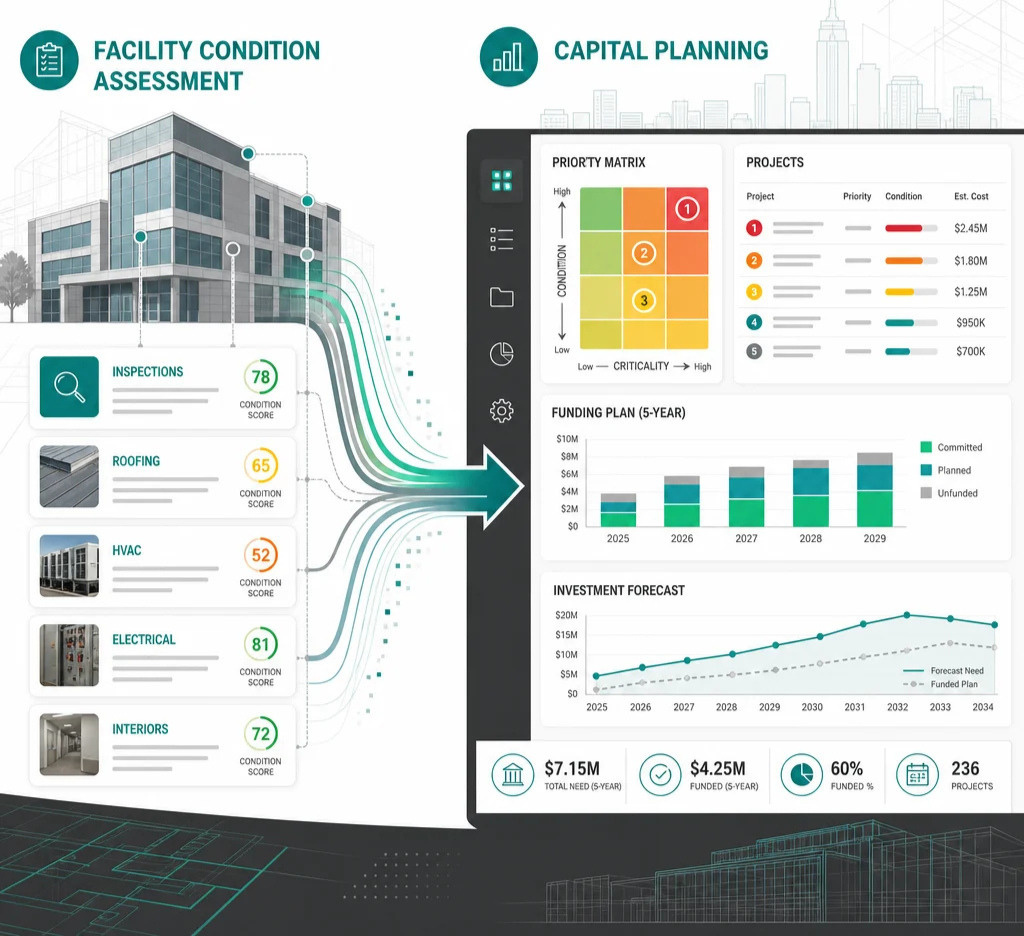 The technology matters. But the real value comes from connecting these steps into one continuous system.
Key Takeaways
- An FCA is the starting point—not the capital plan.
- Conditions need to become costed needs.
- Needs need to become executable projects.
- Prioritize projects and forecast them over time.
- Capital decisions should be traceable back to facility data.
- Connected data is more valuable than isolated reports.
- AI works best with structured, reliable facility data.
- A capital plan should be continuously updated, not treated as a static document.
Want to see how facility data can become actionable capital needs?
Explore how FOUNDATION connects facility condition data to capital planning.

What Is a Facility Condition Assessment?
A facility condition assessment (FCA) evaluates the physical condition of buildings, systems, components, and other assets to identify deficiencies, risks, and potential corrective actions. FCA data becomes far more valuable when connected to cost estimates, prioritization, project planning, and long-term capital forecasting.
A facility condition assessment (FCA) evaluates the physical condition of buildings, systems, components, and other assets to identify deficiencies and potential corrective actions.
But an assessment by itself does not create a capital plan.
An assessment tells you what condition exists. A capital plan must determine what should happen, when it should happen, and how much it will require.
That distinction is critical.
How Facility Condition Assessments Support Better Capital Planning
A facility condition assessment supports capital planning by providing the data needed to identify capital needs, estimate costs, prioritize investments, develop projects, and forecast when work should occur.
Intellis CEO Steven Warshaw's presentation from the Campus FM Technology Association Conference on what we've learned about Condition Assessment Innovation and Justifiable Capital Plans from working with the New York City School System over the past 20 years.
As Warshaw explained in his presentation, a condition is not necessarily a need. A need takes the observed condition and translates it into an action and an estimated cost.
For example:
Condition:
A roof membrane is deteriorating.
Need:
Replace the affected roof system.
Project:
Develop and execute a roof replacement project.
Capital plan:
Determine when the project should occur, how much it will cost, and how it fits within the organization's available funding and priorities.
Each step adds another layer of decision-making.
The Four Steps From Facility Assessment to Capital Planning
A mature capital planning process can be organized into four connected stages.
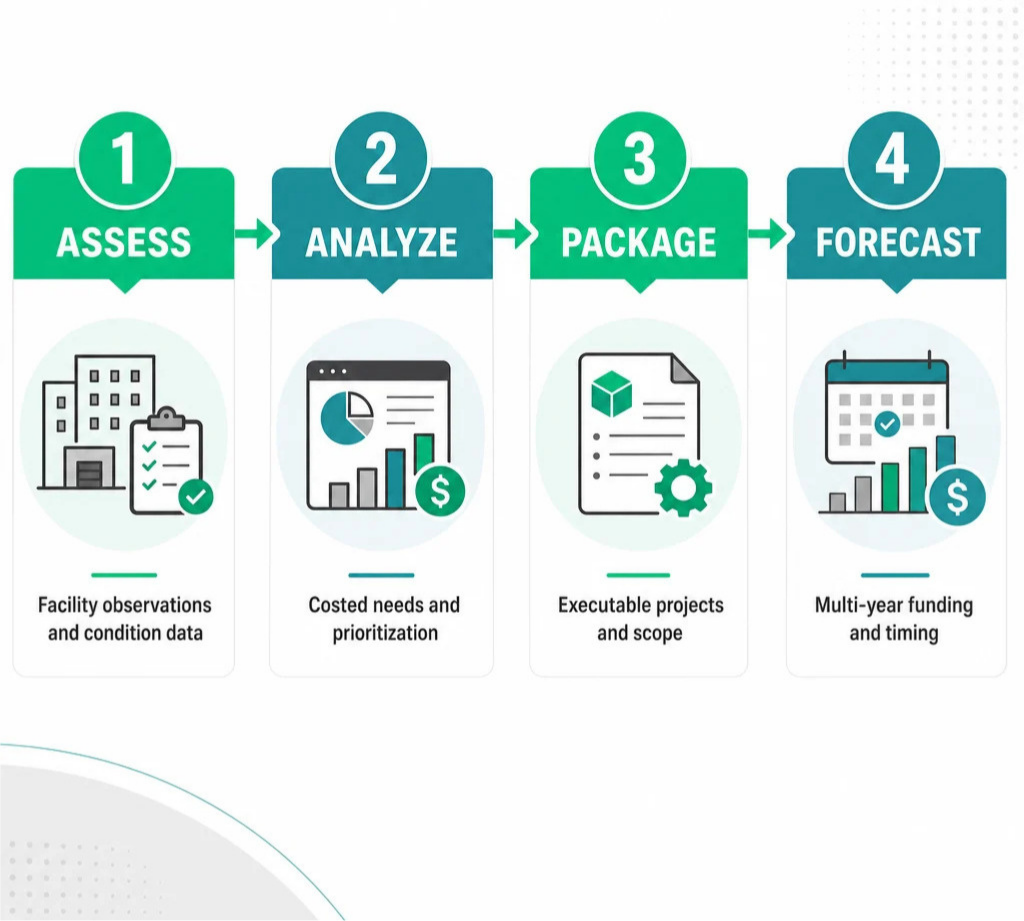
1. Assess: Establish a Reliable Picture of Facility Conditions
Everything starts with data.
Facility teams need to understand the condition of their buildings, grounds, systems, and components before making informed capital decisions.
The challenge is that large organizations often collect this information inconsistently.
Different inspectors may use different terminology. Assessments may be completed in spreadsheets or paper forms. Photos may not be connected to observations. Information may be difficult to compare across assessment cycles.
At small scale, those problems may be manageable.
At hundreds or thousands of facilities, they become a major capital planning problem.
A scalable FCA program needs a standardized methodology.
That means creating consistent lists of:
- Facilities and locations
- Building components
- Deficiency types
- Observations
- Units of measure
- Unit costs
- Condition ratings
- Recommended actions
In the large-scale program described by Warshaw, the assessment methodology included roughly 10,000 potential line items. The system was designed to guide inspectors through the process rather than relying solely on training and manuals to produce consistent results.
The goal is simple:
Make facility data consistent enough to compare.
2. Analyze: Turn Conditions Into Costed Needs
Once the condition data has been collected, the next question is:
What will it take to address those conditions?
This is where an assessment becomes useful for capital planning.
Translate each deficiency into a potential action with an estimated cost.
For example:
Roof deficiency → Roof repair or replacement → Estimated quantity × unit cost → Costed need
But estimating that cost requires more than applying a generic price.
Costs may depend on:
- Component type
- Quantity
- Location
- Age
- Material
- Labor
- Local market conditions
- Inflation
- Escalation
- Organizational policies
- Expected deterioration over time
The presentation describes a granular cost methodology involving thousands of unit costs that can be reviewed and updated over time.
This creates an important distinction that capital planners should keep in mind:
The cost of a need is not necessarily the cost of the project.
That sounds like a small distinction, but it can have major implications for capital budgets.
A collection of individual deficiencies may ultimately be packaged into a larger project. That project can introduce additional design, construction management, contingency, soft costs, escalation, and other expenses.
If organizations use only the raw cost of individual deficiencies to establish their capital request, they may significantly underestimate what it will actually take to execute the work. Warshaw highlighted the importance of maintaining these two cost levels.
3. Package: Turn Individual Needs Into Executable Projects
A capital plan cannot simply say:
"We have $500 million of facility deficiencies."
That is a statement of need, not a project plan.
Capital work has to be packaged into projects that can actually be executed.
A project needs:
- A defined scope
- A beginning and end
- An estimated cost
- A schedule
- Milestones
- Cash flow
- A relative priority
This is where automation can dramatically change the scale of capital planning.
Instead of manually reviewing every deficiency and deciding which ones might become projects, you can use rules and project templates to automatically generate potential projects.
The point isn't that every potential project will eventually be funded.
The point is that you can model the possibilities before deciding which ones to execute.
In the case study presented by Warshaw, the organization executed about 5,000 projects over five years, while the system generated about 30,000 potential projects. That larger pool enabled the organization to evaluate different scenarios and understand the financial implications of alternative decisions.
That is a fundamentally different approach to capital planning.
Instead of asking:
"What projects can we afford?"
you can begin asking:
"What happens if we prioritize these projects differently?"
4. Forecast: Build a Capital Plan Around Real Constraints
Once you've identified potential projects, you need to schedule them.
This is the forecasting stage.
A capital forecast considers:
- Available funding
- Project priorities
- Project timing
- Cash flow
- Organizational policies
- Strategic initiatives
- Enrollment or population projections
- New construction needs
- Sustainability goals
- Other non-condition-based needs
The result is a multi-year plan that shows what should happen, when it should happen, and what it should cost.
But a good capital plan isn't static.
Budgets change. Project costs change. Schedules change. Conditions deteriorate. Priorities shift. New information becomes available.
That means capital planning should operate as a continuous cycle rather than a once-every-five-years exercise.
Assess → Analyze → Package → Forecast → Update → Repeat
Warshaw described this as two interconnected cycles: one that refreshes conditions, needs, projects, and forecasts, and another that updates projects as they move through execution.
Is Your Capital Planning Process Ready for a Data-Driven Approach?
Use the Facility Capital Planning Checklist to evaluate your current approach—from condition assessment and prioritization to project planning, forecasting, and stakeholder reporting.
Why Traceability Matters in Capital Planning
One of the most important concepts in a defensible capital plan is traceability.
A decision-maker should be able to look at a capital project and ask:
Why is this project here?
The answer shouldn't be:
"Because someone put it on the list."
It should be possible to trace the project back through the planning process:
Capital Project → Need → Deficiency → Facility Component → Field Observation
That connection creates confidence in the plan.
It also makes it easier to explain capital requests to executives, boards, finance teams, elected officials, auditors, and the public.
A well-structured capital planning system can preserve that chain of evidence from the original field observation to the recommended project.
This is particularly important for organizations that need to defend capital budgets with real data.
Your Facility Data Is More Valuable When It Connects to Other Systems
A facility condition assessment shouldn't exist in isolation.
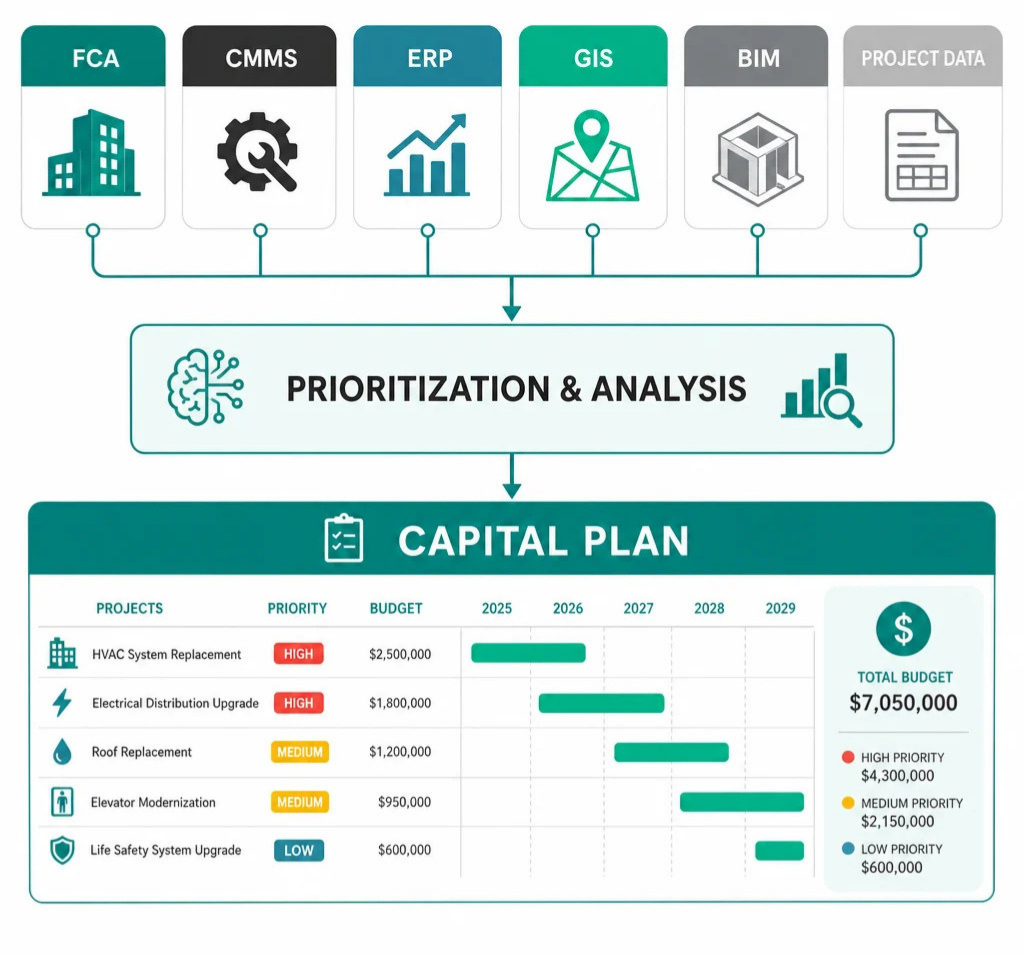 Condition data becomes far more valuable when it connects to other operational and financial information.
Potential data sources include:
- CMMS work orders
- ERP and financial systems
- GIS
- Project management systems
- Space management systems
- BIM models
- Building automation systems
- IoT data
- Energy conservation studies
- Enrollment and population projections
- Roof and façade imaging
- Other facility technology systems
These connections can reveal relationships that are difficult to see when information is trapped in separate systems.
Consider a simple example.
Suppose a facility has repeated moisture-related work orders.
The work order history tells you something is happening.
The condition assessment tells you what condition exists.
A spatial model can help determine where the problem is located.
When those datasets connect, the organization may discover that a small roof deficiency contributes to repeated downstream maintenance problems.
That changes the capital planning conversation.
Instead of repeatedly spending money reacting to symptoms, the organization can evaluate whether addressing the underlying condition would reduce future maintenance costs.
Warshaw described this type of analysis using work order data, roof thermography, and a simplified BIM model to connect seemingly unrelated problems spatially.
The lesson is bigger than BIM:
Facility data becomes more powerful when it is connected.
You Don't Always Need a Perfect Digital Twin
One of the presentation's more interesting ideas is that organizations don't necessarily need a highly detailed digital twin to gain value from spatial facility data.
A "slim BIM" or simplified model can provide enough information to connect work orders, facility conditions, and building components.
For example, if a work order identifies a room number and a component type, a simplified model can potentially establish where that issue exists within the building.
That can be enough to distinguish between different potential causes and identify patterns that would otherwise remain buried in transactional data.
The objective isn't to create the most sophisticated model possible.
The objective is to create enough connected data to answer useful questions.
What Makes a Capital Plan Defensible?
A defensible capital plan is not necessarily the one with the most sophisticated technology.
It is the one where the organization can explain how it arrived at its decisions.
That requires several foundational capabilities:
Standardized data
Different facilities and inspectors need to speak the same data language.
Consistent assessment methodology
Conditions need to be evaluated consistently over time.
Reliable cost models
Needs and projects should reflect realistic costs, not generic estimates.
Transparent prioritization
Organizations need clear rules for deciding what to address first.
Project-level planning
Needs must be translated into executable projects.
Scenario planning
Capital planners should be able to test different funding levels, priorities, and strategies.
Integration
Connect condition data to financial, operational, spatial, and project information where appropriate.
Traceability
Every major capital recommendation should be explainable back to the data that supports it.
Continuous updates
The plan should evolve as conditions, costs, budgets, and projects change.
These capabilities turn a capital plan from a static spreadsheet into a decision-making system.
Where AI Fits Into Facility Capital Planning
AI is generating enormous interest across facility management and capital planning.
But there is an important lesson here:
AI cannot compensate for disconnected or unreliable facility data.
Before an organization can use AI effectively to identify patterns, predict costs, prioritize investments, or recommend capital strategies, it needs structured information that AI can actually interpret.
That means the foundational work still matters:
-
Standardize the data.
-
Connect the data.
-
Preserve the relationships.
-
Track decisions.
-
Then apply intelligence to it.
The presentation's approach to integrating condition assessments, work orders, BIM, GIS, financial information, and project data points toward this broader idea: the more connected the underlying facility information becomes, the more opportunities exist to use analytics and AI to support better decisions.
AI should not replace the capital planning process.
It should make a well-structured process more powerful.
The Real Goal: From Facility Data to Capital Strategy
Facility condition assessments are often treated as a data collection exercise.
Capital planning is often treated as a budgeting exercise.
The strongest programs recognize they're part of the same decision-making process.
-
A condition observation becomes a need.
-
A need becomes a potential project.
-
A project becomes a forecast.
-
A forecast becomes a capital plan.
And the capital plan can ultimately be traced back to the facility data that created it.
That connection is what makes capital planning more transparent, more adaptable, and easier to defend.
The technology has evolved significantly since this approach was first implemented at scale. But the underlying principle remains:
Better capital decisions start with better-connected facility data.
Is Your Facility Data Ready for Strategic Capital Planning?
If your team still manages facility condition data, capital needs, project priorities, and budgets across disconnected spreadsheets and systems, you may spend significant time maintaining data instead of using it to make decisions.
Intellis helps organizations connect facility condition assessment, asset data, prioritization, scenario planning, and capital forecasting in one platform.
See how Intellis can help turn your facility data into a more defensible capital plan.

Frequently Asked Questions
What is the difference between a facility condition assessment and capital planning?
A facility condition assessment evaluates the current condition of buildings, systems, and assets. Capital planning uses that information, along with cost, risk, priorities, funding, and strategic goals, to determine which projects to complete, when to do them, and how to fund them.
How does facility condition assessment data support capital planning?
Facility condition assessment data helps organizations identify deficiencies, estimate capital needs, prioritize projects, forecast future costs, and create evidence-based investment plans.
What are the four steps of facility capital planning?
A practical framework is Assess, Analyze, Package, and Forecast. Organizations assess facility conditions, analyze those findings into costed needs, package needs into executable projects, and forecast project timing and funding across the planning horizon.
How do you prioritize facility capital projects?
Organizations can prioritize capital projects using factors such as condition, risk, urgency, cost, operational impact, compliance requirements, strategic goals, available funding, and the consequences of delaying work.
Why isn't an FCA report enough for capital planning?
An FCA report identifies conditions and deficiencies, but capital planning requires additional steps. Organizations must translate findings into costed needs, prioritize them, package them into projects, forecast their timing and costs, and continually update the plan as conditions and budgets change.
What data should be connected to facility condition assessments?
Depending on the organization, useful inputs can include CMMS work orders, ERP and financial data, GIS, project management data, BIM, space management information, building automation data, energy studies, enrollment projections, and other operational information.
Can AI be used for facility capital planning?
Yes. AI can help organizations analyze structured facility data, identify patterns, support prioritization, and improve decision-making. However, AI depends on reliable, standardized, connected facility data. AI is most useful when it builds on a strong data foundation rather than attempting to compensate for fragmented information.
What makes a capital plan defensible?
A defensible capital plan is supported by consistent data, transparent prioritization rules, realistic cost estimates, documented assumptions, scenario analysis, and traceability from recommended projects back to the underlying facility needs and observations.
Turn Facility Data Into a Capital Plan You Can Defend
See how Intellis FOUNDATION connects facility condition assessment, needs analysis, project prioritization, and long-term capital planning in one system.