

New York City Public Schools manages one of the largest and most complex education portfolios in the United States: more than 1 million students, 1,700+ school buildings, a reported $16.5 billion budget, and an annual capital budget of approximately $4 billion for new construction, excluding maintenance.
How Intellis Helped New York City Public Schools Turn Condition Assessment Data Into Defensible Capital Plans
Managing that portfolio requires more than collecting facility data. Facilities leaders need a clear, repeatable way to understand building conditions, prioritize needs, communicate investment decisions, and adapt plans as conditions and organizational priorities change.
We're excited to share Intellis CEO Steven Warshaw's presentation from the Campus FM Technology Association Conference on what we've learned about Condition Assessment Innovation and Justifiable Capital Plans from working with the New York City School System over the past 20 years.
For more than 20 years, Intellis has worked with the New York City school system to support that process. Using The Foundation System, Intellis helped connect facility condition assessment data with automated, defensible capital planning, giving stakeholders greater transparency into what needs attention, why it matters, and how investments can support long-term facility goals.

The challenge: turning a complex facility portfolio into a clear capital strategy
Large school districts must coordinate decisions across many stakeholders, including facilities teams, finance leaders, school administrators, elected officials, community representatives, and families. Each group needs information presented in a way that supports its role in the capital planning process.
At the same time, facility data changes continuously. New assessments, updated costs, emerging risks, evolving standards, and shifting funding priorities can all affect which projects should move forward.
A successful capital planning process therefore needs to be:
-
Data-driven: grounded in current facility condition and asset information
-
Transparent: clear enough for stakeholders to understand how priorities were established
-
Scalable: capable of supporting thousands of buildings and assets
-
Adaptable: flexible enough to refine methods as needs and conditions change
-
Actionable: designed to move teams from assessment findings to investment decisions
How does facility condition assessment support capital planning?
A facility condition assessment provides the foundation for understanding the physical needs of a building or portfolio. It can capture information about assets, systems, deficiencies, risks, projected costs, and recommended actions.
When that information is centralized and connected to a planning methodology, it becomes more than an inventory of needs. It can help facilities leaders compare priorities, evaluate risk, model funding scenarios, and create a defensible rationale for capital investment.
This connection between assessment data and capital planning was central to Intellis's work with New York City Public Schools.
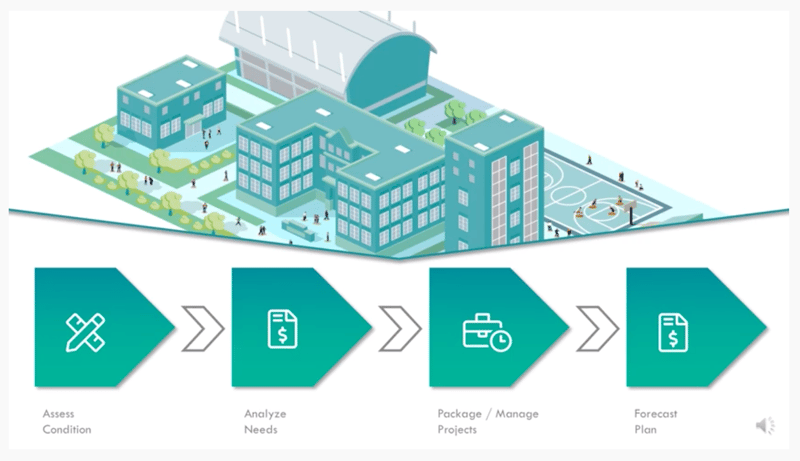
A four-step approach to defensible capital planning
1. Standardize facility condition data
Large portfolios often include data collected by different teams, at different times, and under different assessment standards. A consistent framework helps organizations improve data quality and create a more reliable basis for comparison.
The Foundation System helps teams centralize facility condition assessment data in a configurable, cloud-based platform. This gives stakeholders a shared source of information and makes it easier to maintain consistent workflows across a large portfolio.
2. Organize and analyze building needs
Assessment data becomes more useful when teams can view it in context. Facilities leaders need to understand which systems are affected, how conditions vary across buildings, and where risks or deferred needs may have the greatest operational or financial impact.
With centralized data and dashboards, teams can move from isolated findings to a portfolio-level view of facility conditions. That visibility supports more consistent analysis and makes it easier to identify patterns that may not be apparent when information is reviewed building by building.
3. Prioritize capital investments
School districts rarely have enough funding to address every need at once. Capital planning requires a practical way to rank projects according to factors such as condition, urgency, safety, compliance, cost, operational impact, and long-term organizational goals.
A data-driven prioritization process helps facilities and finance teams explain why one project should move ahead of another. It also gives decision-makers a stronger basis for evaluating tradeoffs and aligning investments with available funding.
4. Build, communicate, and refine the plan
A capital plan must work for more than one audience. Facilities professionals need detailed information. Finance leaders need cost and funding visibility. Executives and public stakeholders need a clear explanation of priorities and expected outcomes.
The Foundation System helps transform facility data into actionable insights, automated reporting, and defensible capital plans. Because the methodology can be refined over time, teams can adjust their approach as new data becomes available, priorities evolve, or planning requirements change.
Why agility matters in long-term capital planning
One of the most important lessons from large-scale facility planning is that a methodology cannot be static. A plan that works today may need to change as building conditions, funding levels, regulations, technology, and organizational goals change.
Agility means having the flexibility to:
-
Update priorities as new assessment data is collected
-
Adjust scoring criteria and planning assumptions
-
Incorporate changing costs and funding scenarios
-
Expand the process as the portfolio grows
-
Adapt workflows to different stakeholder and reporting needs
This flexibility helps organizations maintain a living capital strategy instead of treating planning as a one-time exercise.
What can other school districts learn from New York City?
The New York City experience illustrates several principles that can apply to K-12 districts, higher education institutions, and public-sector organizations managing complex facility portfolios:
1. Condition data should support decisions, not simply document deficiencies.
The value of an assessment increases when teams can use it to prioritize investments and plan next steps.
2. A shared data foundation improves alignment.
Centralized information helps facilities, finance, and executive stakeholders work from the same picture of portfolio needs.
3. Defensible plans require a repeatable methodology.
Consistent criteria make it easier to explain priorities and build confidence in budget recommendations.
4. Capital planning must be designed for change.
Flexible systems and workflows help organizations respond to new information without rebuilding the process from the beginning.
5. Clear communication is part of the planning process.
Stakeholders are more likely to support an investment strategy when they can see how the data connects to the recommendation.
How The Foundation System supports school district capital planning
The Foundation System is facility condition assessment software and capital planning technology designed to help organizations:
-
Centralize facility and asset information
-
Support mobile-first data collection in the field
-
Analyze building conditions across a portfolio
-
Prioritize projects using consistent, data-driven criteria
-
Create automated reporting and defensible capital plans
-
Improve visibility for facilities, finance, and executive teams
-
Refine planning methodologies as organizational needs evolve
-
Connect current facility information to long-term investment decisions
By connecting assessment data, analysis, and planning in one integrated platform, Intellis helps facilities teams spend less time assembling information and more time evaluating priorities and planning for the future.
Build a more defensible capital plan
For school districts and other public-sector organizations, capital planning is both a facilities challenge and a communication challenge. Leaders need to make responsible investment decisions while demonstrating how those decisions support safety, operations, service delivery, and long-term asset performance.
Intellis helps organizations turn facility condition assessment data into actionable insights and automated, defensible capital plans. With The Foundation System, your team can build a clearer view of facility needs, prioritize investments with greater confidence, and adapt the planning process as your portfolio changes.
Ready to connect facility data to a smarter capital strategy?
Request a Foundation demonstration to see how Intellis can support your organization's facility condition assessment and capital planning process.

Frequently asked questions
What is facility condition assessment software?
Facility condition assessment software helps organizations collect, centralize, analyze, and manage information about the condition of buildings, systems, and assets. It can also connect assessment findings to prioritization, reporting, and capital planning workflows.
What is automated capital planning?
Automated capital planning uses structured data, configurable criteria, and software workflows to help organizations evaluate needs, prioritize projects, model scenarios, and produce repeatable capital plans more efficiently.
How can school districts create defensible capital plans?
School districts can create more defensible capital plans by using current condition assessment data, consistent prioritization criteria, transparent scoring or decision rules, documented assumptions, and clear reporting that connects each recommendation to an identified need.
Can a capital planning methodology change over time?
Yes. A scalable capital planning process should allow teams to update data, criteria, costs, funding assumptions, and reporting requirements as conditions and priorities change. The Foundation System is designed to support this ongoing refinement.
How does Intellis support large facility portfolios?
Intellis combines facility condition assessment software, centralized data, automated reporting, and capital planning capabilities in The Foundation System. The platform is designed to help facilities teams manage complex portfolios and turn building data into actionable, long-term investment strategies.

Related resources
-
Learn how Intellis supported facility condition assessment for the New York City Housing Authority.
-
Discover how technology is shaping the future of facilities management in colleges and universities.
-
Discover more about how technology will transform colleges and universities in the future.