
For many facility teams, maintenance follows a familiar pattern:
Something breaks → Someone reports it → Someone fixes it → The ticket gets closed.
Then everyone waits for the next thing to break.
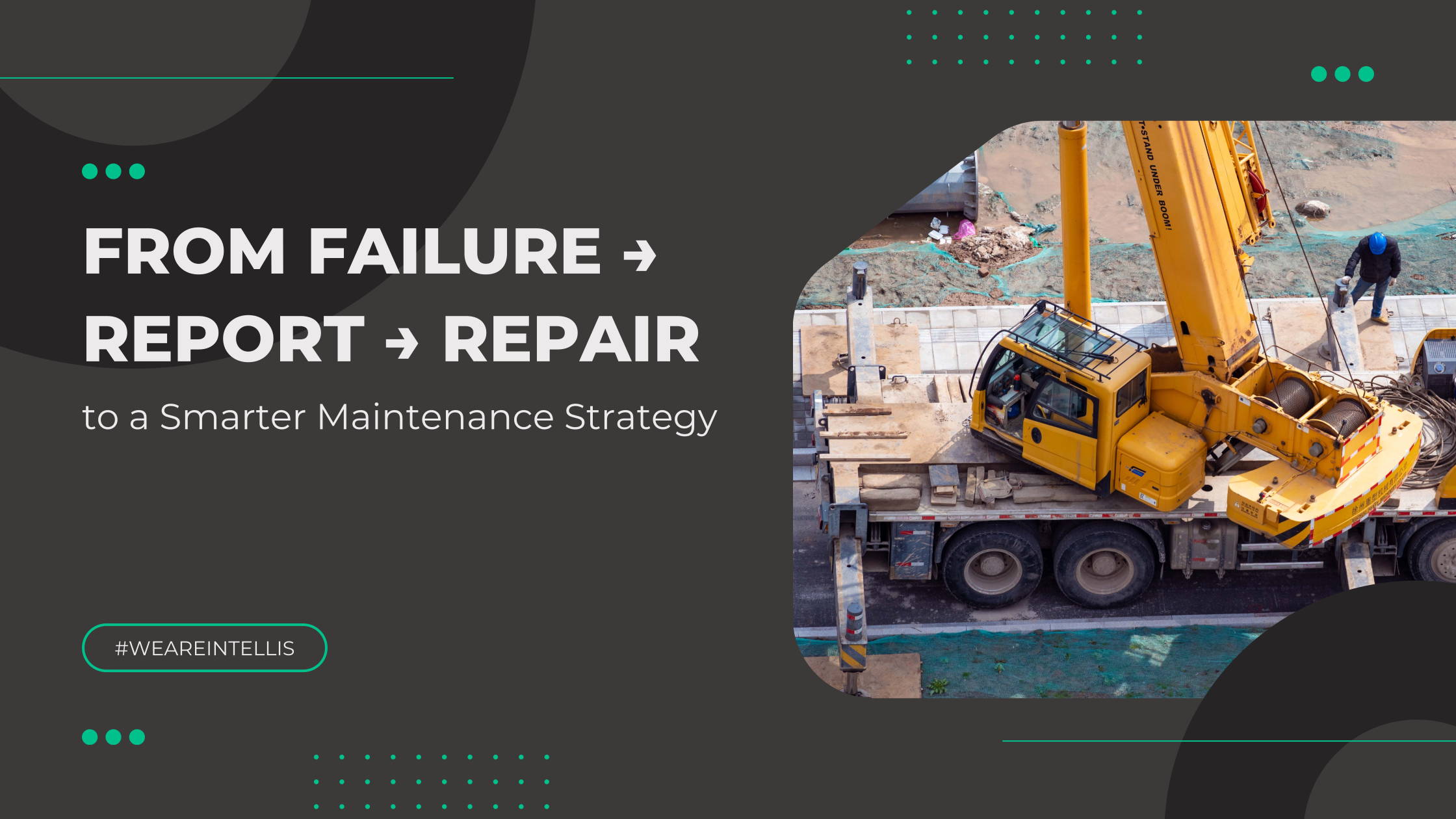
From Failure → Report → Repair to a Smarter Maintenance Strategy
It is easy to understand why organizations end up here. Maintenance teams are busy. Buildings are aging. Resources are limited. Requests arrive through emails, text messages, phone calls, spreadsheets — or sometimes whatever communication app happens to be most convenient.
 The problem is not necessarily the people doing the work.
The problem is that every maintenance event disappears once the immediate problem has been solved.
What failed? How often has it failed before? How much did it cost to repair? Is the asset nearing the end of its useful life? Is this a one-time problem or part of a larger pattern?
Without structured data, those questions are difficult to answer.
And without answers, facility teams remain stuck in reactive mode.
The good news is that moving toward a more proactive maintenance strategy does not have to begin with a massive software implementation. In fact, the best first step is often much simpler.

The Reactive Maintenance Trap
Reactive maintenance is sometimes unavoidable.
Not every asset needs a sophisticated preventive maintenance program. For low-cost, easily replaced equipment, allowing an asset to run until failure may actually be the most practical strategy.
The problem occurs when reactive maintenance becomes the default for everything.
When every maintenance event follows the same cycle —
Failure → Report → Repair → Close
— organizations gradually accumulate several problems.
First, maintenance history becomes fragmented.
Second, teams struggle to identify recurring failures.
Third, resources are allocated based on whichever problem is most urgent at the moment.
And eventually, facility leaders find themselves facing a larger question:
Are we repairing this asset because it makes sense — or because we don't have enough information to make a better decision?
That is where a smarter maintenance strategy begins.

Step 1: Start With an Asset Register
Before creating preventive maintenance schedules, implementing new software, or building dashboards, start with a basic question:
What assets are we actually responsible for?
An asset register creates a structured inventory of the equipment and systems within a facility or portfolio.
At a minimum, teams should begin capturing information such as:
- Asset name
- Asset type
- Location
- Manufacturer
- Model
- Serial number
- Installation date, if available
- Expected useful life
- Responsible department or vendor
An asset register does not need to be perfect on day one.
In fact, trying to document every single asset immediately can stall the entire initiative.
A better approach is to start with the assets that matter most.
A properly structured asset register becomes the foundation for maintenance planning, condition tracking, and eventually long-term capital planning.

Step 2: Determine Which Assets Are Actually Critical
Not every asset deserves the same level of attention.
A failed light fixture in a storage room and a failed air handling unit serving an occupied building should not receive the same maintenance strategy.
This is where asset criticality becomes important.
A simple criticality framework can consider factors such as:
Safety
Could failure create a safety risk or compliance issue?
Operational impact
Would the failure disrupt classes, business operations, visitors, tenants, or other occupants?
Cost
Would failure require expensive emergency repairs or replacement?
Redundancy
Is there backup equipment available?
Consequences of downtime
How long can the organization reasonably operate without this asset?
Asset criticality helps facility teams stop treating every maintenance request as equal.
It also provides a more rational way to decide where to focus preventive maintenance, condition monitoring, and capital investment. Research on maintenance prioritization similarly emphasizes using asset criticality and urgency to support work-order prioritization.
Step 3: Turn Maintenance Events Into Usable Data
Fixing the problem is only part of the job.
The other part is documenting what happened.
Every maintenance event should ideally create a structured record that answers questions such as:
- What asset was involved?
- Where is it located?
- What was the problem?
- When did the issue occur?
- How urgent was it?
- What work was performed?
- Who completed the work?
- What parts were used?
- How much time and money were involved?
This does not mean technicians should spend hours completing paperwork.
The goal is to capture sufficient, consistent information for the organization to identify patterns eventually.
For example:
Why has this pump required three repairs in the past year?
Or:
How much are we spending to maintain this aging HVAC unit?
Or:
Which assets are generating the highest number of emergency work orders?
Those are not just maintenance questions.
They are asset lifecycle questions.
Structured work orders and asset histories enable the transition from anecdotal decision-making to evidence-based decision-making.

Step 4: Build Preventive Maintenance Around the Assets That Matter Most
One common mistake is trying to create a preventive maintenance program for everything at once.
That approach can quickly overwhelm an already busy maintenance team.
Instead, start with the most critical assets.
Identify the 10, 20, or 50 assets where unexpected failure would create the greatest operational, financial, or safety consequences.
Then develop preventive maintenance activities based on factors such as:
- Manufacturer recommendations
- Asset age
- Operating conditions
- Known failure patterns
- Regulatory requirements
- Existing maintenance history
For some assets, a regular preventive maintenance schedule will make sense.
For others, condition monitoring may eventually provide a better approach.
And for low-cost, low-risk equipment, run-to-failure may remain the right strategy.
The goal is not to eliminate reactive maintenance.
The goal is to be intentional about where reactive maintenance makes sense — and where it does not.
Preventive and predictive approaches are most effective when applied based on asset importance, failure consequences, and available condition data rather than treating every asset identically.
Step 5: Measure What Is Actually Happening
Once the organization has basic asset data and structured maintenance records, it can begin measuring performance.
You do not need 50 KPIs.
Start with a few questions that matter.
How much of our work is reactive?
If emergency repairs dominate the workload, that may indicate gaps in preventive maintenance or a growing backlog of aging assets.
Which assets fail most often?
Recurring failures can reveal assets that require deeper investigation, replacement, or a different maintenance strategy.
Are preventive maintenance activities being completed?
Creating PM schedules is not enough. Teams need to understand whether the planned work is actually being completed.
Where are we spending the most money?
Labor, parts, contractor costs, and repeat repairs can help identify assets that are becoming financial liabilities.
Are we repairing assets that should be replaced?
This is where maintenance data becomes particularly valuable.
An asset that repeatedly fails may no longer represent a maintenance problem.
It may be a capital planning problem.
When Maintenance Data Becomes Capital Planning Data
This is the point where maintenance strategy connects directly to long-term facility planning.
Imagine an aging air handling unit.
Over several years, the facility team records:
- Increasing repair frequency
- Higher contractor costs
- Longer downtime
- Declining performance
- Multiple replacement components
- A deteriorating condition score
Eventually, the organization has enough information to ask:
Should we continue repairing this asset — or should we replace it?
That is a fundamentally different conversation from:
"The HVAC keeps breaking. We think we need money."
Instead, facility leaders can say:
"This asset has experienced repeated failures, maintenance costs are increasing, its condition is declining, and replacement is now the more defensible long-term investment."
That is the value of connecting maintenance history, asset condition, lifecycle information, and capital planning.
Intellis has written extensively about this transition from reactive maintenance toward data-driven capital planning and the use of condition data to prioritize investments.
Don't Start With Software. Start With the Questions You Need to Answer.
Technology can absolutely help organizations manage assets, work orders, condition information, and capital needs.
But software alone does not solve the problem of reactive maintenance.
A poorly structured process becomes a poorly structured process inside a new system.
Before evaluating technology, organizations should understand:
-
What assets do we have?
-
Which assets are most critical?
-
What information should we collect during maintenance?
-
Which assets need preventive maintenance?
-
What patterns do we need to identify?
-
How will maintenance information support larger capital decisions?
Once those questions are clear, technology becomes much more valuable.
The system is no longer just a place to store work orders.
It becomes a source of information for operational and financial decision-making.
CMMS platforms are built around this relationship between assets, work orders, preventive maintenance, and maintenance history, making the quality and consistency of the underlying data essential.
A Practical Starting Point
If your organization currently operates on a simple model of:
Failure → Report → Repair → Close
don't try to transform everything overnight.
Start here:
1. Identify your most important assets.
Focus on the equipment and systems where failure would have the greatest consequences.
2. Build a basic asset register.
Capture the essential information needed to identify and manage those assets.
3. Assign a simple criticality rating.
High, medium, and low may be enough to start.
4. Standardize maintenance records.
Make sure every maintenance event creates usable information.
5. Establish preventive maintenance for critical assets.
Start small and expand as the process matures.
6. Review recurring failures and costs.
Look for patterns that indicate larger maintenance or capital issues.
7. Connect maintenance information to long-term planning.
Use the data to determine where repairs, renewals, and replacements should be prioritized.
The transition from reactive maintenance to a smarter facility strategy does not begin with a dashboard.
It begins with understanding your assets.
The Goal Isn't More Data. It's Better Decisions.
Facility teams already generate enormous amounts of information.
The challenge is that the information is often scattered across emails, spreadsheets, contractor reports, work orders, and individual employees' knowledge.
The opportunity is to connect that information.
When maintenance events become structured asset data, facility leaders can begin to see patterns.
When those patterns are combined with condition information and lifecycle data, they can prioritize investments.
And when real data support priorities, capital planning becomes easier to explain—and easier to defend.
The journey from reactive maintenance does not happen all at once.
It starts with one important shift:
Stop treating maintenance events as isolated problems. Start treating them as information about the future of your assets.
Turn Facility Data Into Better Capital Decisions
Maintenance history is only one part of the facility data picture.
Intellis helps organizations collect, organize, and analyze facility condition and asset information to support smarter capital planning. The Foundation platform connects facility data with prioritization and planning tools, helping facility leaders understand where investment is needed and build more defensible capital plans.
Ready to turn your facility data into a clearer capital strategy?
Schedule a demo with Intellis to see how Foundation can help you move from disconnected facility information to data-driven capital planning.