Facilities teams often use separate systems for maintenance, work orders, asset data, and capital planning. Learn how to evaluate when consolidation makes sense, and where fragmented data is costing your organization.
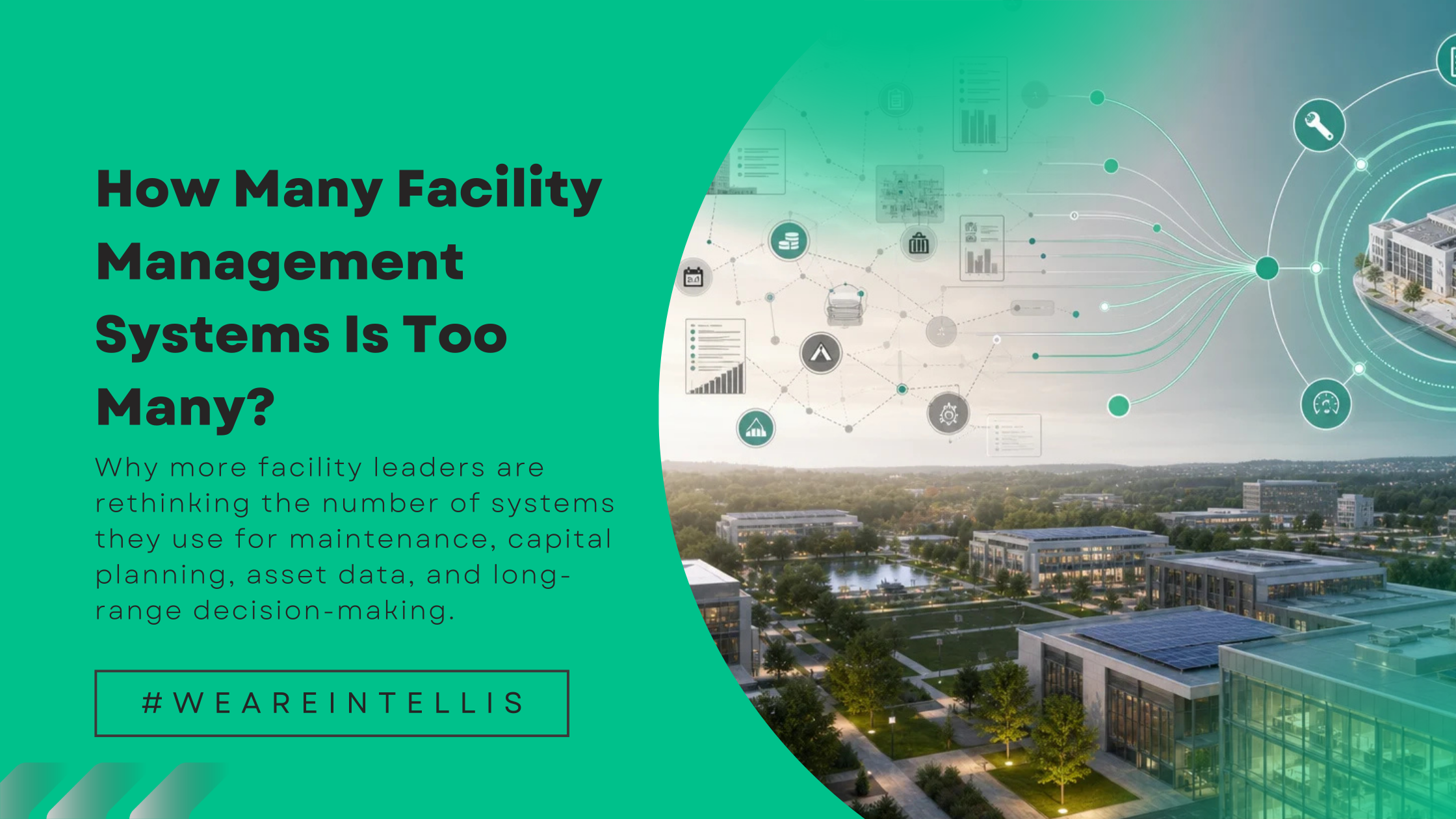
Why more facility leaders are rethinking the number of systems they use for maintenance, capital planning, asset data, and long-range decision-making.
How Many Facility Management Systems Is Too Many?
Why a growing facilities technology stack can create as many problems as it solves, and how to know when it's time to rethink it.
 Most facilities departments do not set out to build a complicated technology ecosystem.
It happens gradually.
A work order system is implemented to help maintenance teams respond faster. An asset management platform is added to keep track of equipment. A facility condition assessment creates a new dataset. Capital planning happens in another system. Floor plans live somewhere else. Photos, reports, and historical records accumulate in shared drives.
Then someone needs to answer what should be a relatively straightforward question:
What facilities should we invest in next, and why?
Suddenly, the answer requires pulling information from multiple systems, exporting spreadsheets, reconciling asset records, tracking down historical data, and asking several departments for information.
The organization has plenty of technology.
What it may not have is a connected view of its facilities.
So, how many facility management systems is too many?
There is no magic number.
But there is a point at which adding another platform no longer makes the organization more efficient; instead, it creates a new problem: systems sprawl.

The Facilities Technology Stack Has Been Growing for Years
Facilities teams are responsible for increasingly complex portfolios, and the software ecosystem around them has grown accordingly.
A single organization might use separate systems for:
- Work order management
- Preventive maintenance
- Asset management
- Facility condition assessments
- Capital planning
- Space and floor plan management
- Energy or sustainability data
- Project management
- GIS and location data
- Occupancy and utilization
- Financial planning and budgeting
Each platform may have been purchased for a perfectly reasonable reason. Many are good at solving the problem they were originally brought in to address.
The issue is not necessarily that an organization has multiple systems.
The issue is what happens between those systems.
When data cannot move easily from one platform to another, or when employees must manually bridge the gaps, the technology stack itself can become another layer of work.
The Hidden Cost of "Best of Breed"
Specialized software has obvious advantages. A platform designed specifically for one function may offer deeper capabilities than a general-purpose alternative.
But there is a tradeoff.
Every additional system introduces questions such as:
- Where is the authoritative version of this data?
- Are we maintaining the same asset information in multiple places?
- How often do records get out of sync?
- Can maintenance history inform capital planning?
- Can facility condition data be viewed alongside occupancy or capacity information?
- How much time does staff spend exporting, importing, and reconciling data?
- Are we paying for functionality that no one actually uses?
The subscription cost of software is easy to see.
The operational cost of disconnected systems is harder to measure.
It shows up in spreadsheets built to fill reporting gaps. It shows up when staff members become the unofficial integration layer between platforms. It shows up when leadership asks for a report, and multiple departments have to reconcile conflicting numbers before anyone feels confident presenting an answer.
The most expensive technology may not be the platform with the highest subscription fee. It may be the collection of systems your team has to work around constantly.
When More Software Doesn't Mean More Visibility
Imagine a facilities team that has excellent information about individual assets.
They know the age of a piece of equipment. They have maintenance records. They may even have detailed work order history.
Another system contains facility condition data and deferred maintenance needs.
A third platform contains capital planning information.
Separately, those datasets may be useful.
Together, they can answer much more important questions.
For example:
- Which assets are generating the highest maintenance burden?
- Which systems are approaching the end of their useful life?
- Where should replacement be prioritized over continued repair?
- How will declining or growing utilization affect future capital needs?
- Which facilities represent the greatest risk over the next five or ten years?
- What happens if the available capital budget is reduced?
- Which projects can be deferred—and what are the consequences?
These are not simply maintenance questions.
They are strategic planning questions.
And strategic planning becomes significantly more difficult when the data needed to answer them is scattered across multiple platforms.
Capital Planning Is Where Fragmented Data Becomes Most Visible
Capital planning requires organizations to look beyond a single asset or individual work order.
Leaders need to understand the broader context.
That may include:
- Facility condition
- Asset age and expected useful life
- Deferred maintenance
- Repair and replacement history
- Preventive maintenance activity
- Historical work orders
- Facility utilization
- Occupancy or enrollment trends
- Building capacity
- Project costs
- Available funding
- Geographic and portfolio-level considerations
The more disconnected those data sources become, the harder it is to create a complete picture.
A question like "What should we invest in next?" can quickly turn into a research project.
Someone has to pull data from one system. Someone else provides information from another. A spreadsheet is created to combine the information. Assumptions are made. Numbers are updated manually.
By the time the analysis is complete, the underlying data may have already changed.
This is one reason more facilities organizations are rethinking the relationship among maintenance, asset data, facility condition assessments, and capital planning.
These functions may serve different purposes, but they should not have to exist in completely separate worlds.
How to Know If Your Facilities Technology Stack Is Too Fragmented
You do not need to consolidate software simply because you use multiple systems.
In many cases, separate platforms are the right solution.
The better question is whether your current technology ecosystem is creating unnecessary friction.
Here are a few signs it may be time for a closer look.
1. Your team maintains the same data in multiple systems
If asset information, facility records, or project data must be entered or updated in several places, inconsistency is almost inevitable.
Duplicate data entry also creates an ongoing labor cost that rarely appears in a software budget.
2. Important reports require spreadsheets to connect the dots
Spreadsheets are useful tools.
But if they have become the primary method for combining data from multiple enterprise systems, they may be compensating for a larger technology problem.
3. You cannot easily connect maintenance activity to capital decisions
Work order history can provide valuable context about an asset or building's performance.
If that information cannot inform longer-term planning, the organization may be making capital decisions without access to part of the story.
4. Different departments have different versions of the truth
Facilities, finance, operations, IT, and executive leadership should not have to debate which spreadsheet or system contains the correct number.
A reliable source of truth becomes increasingly important as decisions become more expensive.
5. You're paying for features you don't use
Software evaluations often focus on what a platform can do.
A better question is:
What are we actually using?
Organizations may discover that they are paying for extensive functionality that is rarely used, or maintaining separate systems that perform overlapping functions.
6. Adding a new system creates another data silo
If every new initiative requires another standalone platform, the organization may need to step back and evaluate its overall technology architecture rather than continuing to add tools one at a time.
Before You Consolidate, Conduct a Technology Stack Audit
Replacing software without understanding the existing environment can create a new set of problems.
Before making a change, start with an inventory.
For every major facilities system, ask:
What does it cost?
Look beyond the annual subscription.
Consider:
- Licensing
- Implementation costs
- Integrations
- Internal administration
- Training
- Consulting
- Custom reporting
- Staff time required to maintain the system
How is it priced?
Understanding whether a platform is priced by users, assets, facilities, square footage, modules, or another metric can help organizations model how costs will change as their portfolios evolve.
What functionality is actively being used?
This is one of the most valuable questions in a technology audit.
Document:
- Essential functionality
- Frequently used functionality
- Occasionally used functionality
- Features that were purchased but are rarely or never used
The goal is not to criticize previous technology decisions. Requirements change, organizations change, and software usage changes.
The goal is to understand what the organization actually needs today.
What data would need to move?
Historical work orders, facility condition data, asset records, photos, floor plans, and project history can all have long-term value.
Before replacing or consolidating systems, organizations should understand:
- What data exists
- Where it lives
- What format it is in
- How clean and complete it is
- What needs to be retained
- What can be migrated or converted
Modern data conversion and AI-assisted tools can reduce manual work, but migration should still be treated as a strategic process, not an afterthought.
Consolidation Doesn't Have to Mean Replacing Everything
One of the biggest misconceptions about technology consolidation is that it requires a massive, organization-wide software replacement.
It doesn't.
A phased approach can often reduce risk.
An organization might begin by improving one area where fragmented information is creating the greatest problem.
| Question | Why It Matters |
|---|---|
| What does this system cost? | Identifies financial overlap |
| How is pricing structured? | Helps model future costs |
| What functionality is actively used? | Reveals unused software investment |
| What data would need to migrate? | Identifies implementation complexity |
| Who depends on this system? | Prevents disruption during consolidation |
For example:
Phase 1: Facility condition and capital planning
Create a more reliable system for assessing facility needs, prioritizing projects, and developing capital scenarios.
Phase 2: Asset and facility data
Connect condition data to a broader view of assets, buildings, and portfolio information.
Phase 3: Operational information
Bring relevant maintenance history, preventive maintenance data, or work order information into the planning process.
Phase 4: Enterprise reporting and decision support
Create dashboards and reporting tools that help different stakeholders—from facilities teams to finance leaders and the public—understand the same underlying data.
The right path will look different for every organization.
The important point is that modernization does not always have to be a rip-and-replace project.
Start With the Decisions You Need to Make
The best way to evaluate a facility's technology stack may not be to start with the software.
Start with the decisions.
Ask:
What decisions are difficult for us to make today?
Then work backward.
If leadership needs to prioritize $100 million in facility needs against a limited capital budget, what information is required?
If a building system is generating repeated maintenance costs, what data would help determine whether it should be repaired or replaced?
If utilization is changing across a portfolio, how should that influence future investment?
If the information needed to answer those questions is spread across five different systems, the problem may not be the quality of any individual platform.
The problem may be the architecture connecting them.
A Connected Foundation for Better Facility Decisions
At Intellis, we believe facility data should do more than sit in separate systems.
Foundation is designed to help organizations connect facility condition information, asset data, capital needs, planning scenarios, and other critical portfolio information in a more unified environment.
For some organizations, that may begin with facility condition assessments and capital planning.
For others, it may involve asset data, historical information, floor plans, operational workflows, or broader enterprise reporting.
The goal is not necessarily to put every facilities function into a single platform.
The goal is to make sure the information required to make important decisions can actually work together.
Because facilities teams do not need technology for technology's sake.
They need answers.
They need to understand what they own, its condition, what it will cost to maintain, where the risks are, and where limited capital will have the greatest impact.
And if answering those questions requires opening five different systems and building a spreadsheet to connect them, it may be time to ask:
How many facility management systems is too many?
The answer may be simpler than counting platforms.
It's when your technology starts making it harder, not easier, to understand your facilities and make confident decisions.
This is the problem Foundation was designed to address.
Intellis helps organizations bring facility condition data, asset information, capital requirements, planning scenarios, and related operational data into a more connected environment—without forcing every organization into the same implementation model.
For some teams, the starting point may be capital planning. For others, it may be facility assessments, asset data, or a broader effort to create a more reliable source of truth.
Ready to Take a Closer Look at Your Facilities Technology Stack?
If your organization is managing facility condition data, maintenance information, asset records, and capital planning across multiple systems, the first step is not necessarily replacing everything.
It's understanding where the gaps, overlaps, and disconnected data are creating unnecessary work.
Foundation helps organizations build a more connected foundation for facility and capital planning decisions.
Talk with Intellis about your facility data and capital planning environment →