

Higher education facilities teams are being asked to do more with limited resources. Aging buildings, deferred maintenance, sustainability goals, and competing capital requests all place pressure on institutions to make decisions that are both strategic and defensible.
The challenge is not simply collecting facility condition data. The challenge is turning that data into a clear plan: which projects should come first, why they matter, what they will cost, and how they support the institution's long-term goals.
Why facility condition data alone is not enough
A condition assessment can show where deficiencies exist. It does not automatically determine which needs should receive funding first.
That decision requires a broader view of each facility and project, including:
- The urgency and severity of the condition
- Safety, compliance, and operational risk
- Estimated cost and lifecycle impact
- The effect on students, faculty, staff, and campus operations
- Alignment with institutional priorities and long-term plans
Without a consistent way to evaluate these factors, capital planning can become difficult to explain. Teams may have accurate information, but still struggle to create a shared point of view across facilities, finance, executive leadership, and governing stakeholders.

Four factors for prioritizing higher education capital needs
1. Current condition and urgency
Start with a clear understanding of the physical condition of buildings, systems, and major assets. Consistent assessment data helps teams identify which deficiencies require immediate attention and which can be addressed through a longer planning horizon.
The goal is not to treat every need as equally urgent. It is to establish a reliable baseline for comparing projects across buildings and campuses.
Turn facility condition data into a defensible capital plan.
See how Foundation helps organizations assess buildings, prioritize capital needs, and plan strategically.

2. Risk and compliance
A project's priority should reflect more than its visible condition. Safety concerns, regulatory requirements, environmental exposure, and the potential for service disruption can significantly change the order in which work should be completed.
Connecting these factors to condition data gives decision-makers a clearer view of where delayed investment could create greater operational or financial risk.
3. Cost and lifecycle impact
The lowest-cost project is not always the best first investment. A short-term repair may postpone a larger expense, while a planned replacement may reduce recurring costs and improve long-term asset performance.
Evaluating project cost alongside useful life, maintenance requirements, energy performance, and the consequences of delay helps institutions compare options more effectively.
4. Institutional and operational impact
Campus facilities support teaching, research, housing, healthcare, athletics, administration, and student life. A project's effect on those activities should be part of the prioritization process.
A facility improvement that protects a critical program or prevents a major disruption may warrant a higher priority than a project with similar condition scores but less operational impact.
Build a shared framework for capital planning
Once the relevant factors are defined, institutions can create a repeatable framework for evaluating capital needs. A strong framework should help teams:
- Centralize facility condition and asset data.
- Apply consistent criteria across buildings and campuses.
- Rank projects according to urgency, risk, cost, and impact.
- Compare funding scenarios and planning horizons.
- Connect individual projects to broader institutional goals.
- Communicate the reasoning behind priorities clearly.
This approach makes capital planning easier to manage and easier to defend. Facilities leaders can show how recommendations were developed, finance teams can evaluate investment requirements, and executives can make decisions with a clearer understanding of the tradeoffs.
Make budget conversations more data-driven
Capital requests are stronger when they connect a defined facility need to a measurable institutional outcome.
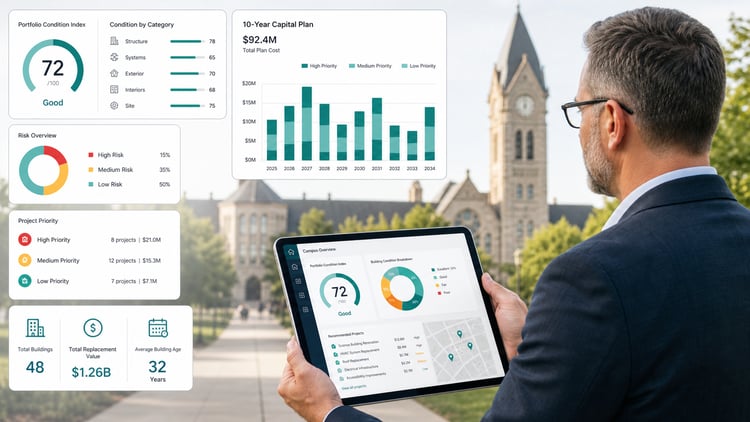
Instead of presenting a project as an isolated request, teams can explain:
- What condition or risk is driving the need
- What may happen if the project is delayed
- How the investment supports safety, continuity, efficiency, or sustainability
- How the project compares with other needs across the portfolio
- What funding approach best supports the institution's long-term plan
This gives stakeholders more than a project list. It gives them a transparent decision framework.
Improve collaboration across campus
Higher education capital planning often involves people with different priorities and responsibilities. Facilities teams understand building conditions. Finance teams focus on affordability and timing. Executive leaders consider institutional strategy. Information technology and operations leaders may evaluate systems, data, and implementation requirements.
A centralized, accessible view of facility data helps these groups work from the same information. It also reduces the time spent reconciling inconsistent records and makes it easier to maintain alignment as plans change.
Use technology to connect assessment and strategy
The right platform can help institutions move from facility condition assessment to strategic capital planning without losing the connection between the two.
Foundation by Intellis helps higher education teams centralize facility condition information, prioritize capital needs, and build data-driven long-term plans. With a cloud-based platform and configurable mobile data collection, teams can improve visibility across complex portfolios and turn assessment information into actionable planning insight.
The result is a more connected process — from collecting information in the field to evaluating projects and communicating priorities to decision-makers.
A practical starting point
If your institution is reviewing its capital planning process, begin with three questions:
- Do we have a current, consistent view of facility conditions across the portfolio?
- Can we explain why one project should be prioritized over another?
- Can our data support a clear, defensible conversation about funding?
If the answer to any of these questions is uncertain, the next step may not be collecting more information. It may be creating a more connected way to organize, evaluate, and use the information you already have.
Want to compare approaches? Connect with Intellis to discuss how higher education teams are turning facility condition data into clearer capital priorities and long-term plans.